
By Nooriyah R., Oregon notary public, Apostille Authentications, Lake Oswego office
If a bank in Hong Kong, a company registry in Europe or a lawyer handling a property purchase abroad has asked your company for an apostilled certificate of incumbency, you have probably already discovered the awkward part: no U.S. state government issues one. You can’t order it from your Secretary of State the way you order a certificate of good standing.
That doesn’t mean you’re stuck. A certificate of incumbency is a document your company prepares and an officer signs before a notary. The notary’s state then attaches the apostille. Done in the right order, it’s usually one of the faster documents in an international packet. Done in the wrong order, it’s the one that gets sent back.
We notarize and apostille these certificates for companies opening foreign bank accounts, forming subsidiaries abroad and buying or selling property overseas. This guide walks through what the document is, why your state won’t issue it, how to get it notarized and apostilled, and what to do when the bank says it must come “from your registered agent.”
What a certificate of incumbency is
A certificate of incumbency (sometimes called an incumbency certificate, officer’s certificate or register of directors) is a signed statement from the company that lists who currently holds its key positions and who is authorized to act for it. Foreign banks use it to confirm that the people opening the account or signing the loan papers actually have authority to do so.
It typically shows:
- The company’s exact legal name, state of formation and state file number
- The current officers, directors, managers or members, with their titles
- Who is authorized to sign on the company’s behalf, and for what
- Specimen signatures of the authorized signers (many banks ask for these)
- The date, and the signature and title of the person certifying it
Certificate of incumbency vs. secretary’s certificate
The two are related but not identical. A certificate of incumbency answers “who holds which office.” A secretary’s certificate usually goes further: the corporate secretary certifies that attached documents, such as the bylaws, the operating agreement or a board resolution, are true, complete and still in force. Banks and registries often ask for both, or for a secretary’s certificate that includes an incumbency section. Read the request carefully and give them the document they named.
The LLC version and the corporation version
For a corporation, the corporate secretary normally signs, relying on the bylaws and board records. For an LLC, which has no corporate secretary by default, a manager or managing member usually signs, relying on the operating agreement. Either way, the signer certifies facts about their own company, which is why the company prepares it.
Why your Secretary of State won’t issue one
States keep records of what companies file with them: articles, annual reports, mergers. They don’t certify who your current officers are. Harvard Business Services, a Delaware registered agent, puts it plainly: Delaware “does not issue a state document that confirms current ownership or management authority” (Harvard Business Services). Oregon, Washington, Texas and Virginia work the same way.
What a state can give you is a certified record of existence: a certificate of good standing, certificate of existence or certificate of fact, and certified copies of your filed articles. Those are state records, so the state that issued them apostilles them. They often travel in the same packet as the certificate of incumbency, but they don’t replace it.
When the bank says it must be “issued by your registered agent”
This is a snag we see often, and few guides explain it. HSBC Hong Kong’s account-opening checklist for companies formed overseas, for example, asks for “a Certificate of Incumbency (COI) issued by Registered Agent within 6 months,” or alternatively an official company search report issued within six months (HSBC Hong Kong).
That wording is common in places such as the British Virgin Islands and the Cayman Islands, where registered agents routinely issue incumbency certificates. In the U.S. it’s different. Some Delaware registered agents offer the service, but many agents in other states don’t. If your bank uses this language, you have three practical options:
- Ask your registered agent first. If it issues incumbency certificates, ask whether it will sign before a notary so the document can be apostilled.
- Ask the bank, in writing, whether an officer-signed certificate is acceptable. Some institutions accept a certificate signed by a company officer, notarized and apostilled, especially when it’s paired with a state certificate of good standing. Get the answer in an email before you start.
- Offer the official alternative. If the bank accepts an official registry extract, a state certificate of good standing or existence, apostilled by your state, may satisfy it.
We can’t promise how a particular bank will decide, and neither can anyone else. Only the receiving institution decides what it accepts. But we can make sure that whichever version you send is notarized and apostilled correctly the first time.
How to prepare, notarize and apostille a certificate of incumbency
Step 1: Get the receiving party’s exact requirements
Before anyone signs anything, get the bank’s or registry’s document list in writing. Look for three details: whether they want an apostille or only a certified true copy, how recent the document must be, and whether they need a translation. Many banks ask only for certified true copies of some documents, not apostilles, and the difference changes both the price and the timeline.
Step 2: The company prepares the certificate
The certificate should be prepared by your company, its corporate secretary or your attorney, using your current operating agreement or bylaws, minutes and resolutions. Make sure names and titles match your other records exactly, including any foreign spellings on passports.
We’re notaries and an apostille service, not a law firm, so we don’t draft corporate documents or advise on what yours should say. What we do is check, before you sign, that the document is ready to be notarized and apostilled: complete signature blocks, no blanks, a correct date, and room for the notarial certificate.
Step 3: Sign in front of a notary, in ink
The authorized officer signs before a notary, who adds a complete notarial certificate. Usually that’s an acknowledgment (the signer confirms they signed willingly) or a jurat (the signer swears the contents are true). The signer, or the bank’s instructions, decides which act is needed. The notary can’t choose it for you.
We strongly recommend wet-ink notarization for documents going to foreign banks. Delaware, for instance, says it “will not accept documents that are notarized remotely or electronically for apostille” (Delaware Division of Corporations), and acceptance of online notarizations abroad is uneven.
Step 4: Get the apostille from the notary’s state
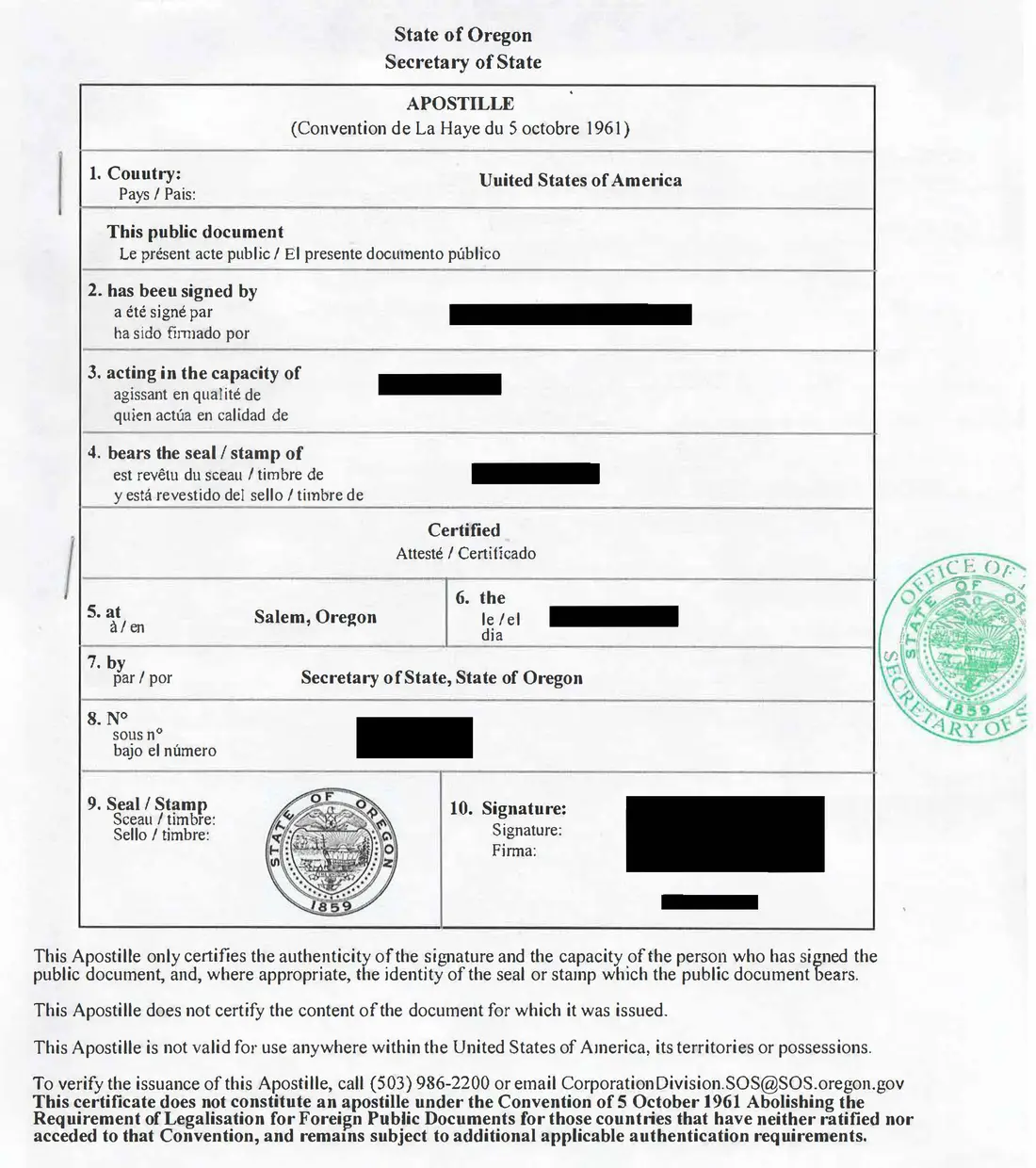
This is the step people most often get wrong. A notarized document is apostilled by the state where the notary is commissioned, not the state where your company was formed. A Delaware LLC whose manager signs in Hillsboro, Oregon, gets an Oregon apostille on that certificate.
Current state fees for an apostille on a notarized document:
| State | State fee per apostille |
|---|---|
| Oregon | $10 (OAR 160-100-0040) |
| Washington | $15 (Washington Secretary of State) |
| Texas | $15 (Texas Secretary of State) |
| Virginia | $10 (Secretary of the Commonwealth) |
| Delaware (commercial documents) | $30 (Delaware Division of Corporations) |
The apostille confirms the notary’s signature and seal. It does not confirm that the officers listed are correct. That responsibility stays with the company.
Step 5: Translate if the destination requires it
Many non-English-speaking countries require a certified translation of the certificate and of the apostille, and some (Brazil, Spain and Mexico among them) require translators credentialed in that country. Ask the receiving party before you order a translation. Where a U.S. certified translation is accepted, our certified translation service can prepare it.
The two-state packet: when your company and your signer are in different states
Here is a situation we handle regularly for business clients. A company formed in Delaware, with its managers in Oregon, Washington, Texas or Virginia, needs a bank packet that typically includes:
- A Delaware certificate of good standing, apostilled by Delaware, because Delaware issued it
- A certificate of incumbency signed in Oregon (or Washington, Texas, Virginia), notarized there and apostilled by that state
- A board or member resolution naming the authorized signers, notarized and apostilled the same way
That’s two different state offices for one packet. If either piece goes to the wrong office, it comes back unprocessed and the clock restarts. Because we have offices in Hillsboro and Lake Oswego, Oregon, Vancouver, Washington, Houston, Texas and Herndon, Virginia, we notarize the documents where you sign and route each one to the right state office. Same-day service is available for Oregon, Washington, Texas and Virginia documents, depending on when we receive them.
What a typical business packet costs
Our fee is $195 for the first document and $65 for each additional document in the same order, plus the government fees. Here are three common packets:
| Packet | Documents | Our service fee | State apostille fees |
|---|---|---|---|
| Oregon LLC opening a foreign bank account | Certificate of existence, certified articles, notarized certificate of incumbency, notarized member resolution (4) | $390 | $40 (4 × $10) |
| Texas corporation forming a subsidiary abroad | Certificate of fact, certified certificate of formation, notarized secretary’s certificate, notarized certificate of incumbency, notarized power of attorney (5) | $455 | $75 (5 × $15) |
| Washington LLC buying property abroad | Certificate of existence, notarized resolution, notarized power of attorney (3) | $325 | $45 (3 × $15) |
State fees for ordering certified copies and certificates of existence are extra and vary by state. Countries outside the Hague Apostille Convention, such as the United Arab Emirates, need authentication and embassy legalization instead, which we quote by country. See our pricing page for current rates, and our guide to apostilling business documents for other corporate records.
Checklist before you send your packet abroad
- The bank’s or registry’s written document list, showing apostille or certified copy for each item
- Destination country confirmed as a Hague Convention member on today’s date (see the current list)
- State of formation (for state records) and state where the officer signs (for notarized documents)
- A fresh certificate of good standing or existence
- Certificate of incumbency prepared from current records, with names matching passports
- Board or member resolution naming authorized signers
- Signer’s valid photo ID and an in-person notary appointment
- Translation requirements, and whether the translator must be in the destination country
- Your deadline, counted back from the bank appointment or closing date
Mistakes that get incumbency packets rejected
- Sending a photocopy. Articles and good standing certificates must be certified copies from the state, not office printouts. Notaries generally can’t certify copies of public records.
- Getting the apostille from the wrong state. The notary’s state apostilles notarized documents; the issuing state apostilles state records.
- Using online notarization for a document headed to a state or bank that won’t accept it.
- Letting the dates go stale. Many banks want documents issued within the last few months. HSBC Hong Kong, for example, asks for six months.
- Missing the resolution. A certificate of incumbency says who the officers are. Banks often also want a resolution saying those officers may open this specific account.
Frequently asked questions
Does my state issue a certificate of incumbency?
No. Oregon, Washington, Texas, Virginia and Delaware don’t issue one. Your company prepares it, an authorized officer signs it before a notary, and the notary’s state apostilles it.
Who can sign a certificate of incumbency for an LLC?
Usually a manager or managing member authorized under the operating agreement. For a corporation, it’s usually the corporate secretary or another authorized officer.
Can a notary apostille my certificate of incumbency?
No. A notary notarizes the signature. The apostille comes from the Secretary of State, or equivalent office, in the state where the notary is commissioned.
Which state apostilles it if my company is in Delaware but I sign in Oregon?
Oregon. Notarized documents are apostilled by the notary’s state. Your Delaware certificate of good standing is still apostilled by Delaware.
Does an apostille prove the officers listed are correct?
No. The apostille only verifies the notary’s signature and seal. The company is responsible for the accuracy of the certificate.
How long is a certificate of incumbency valid?
It reflects the facts on the date it is signed. Banks set their own limits, often a few months. HSBC Hong Kong asks for six months. Check with the receiving institution.
Do I need an apostille or just a certified true copy?
It depends on the bank. Some ask for apostilles on every document; others accept true copies certified by a lawyer, notary or accountant. Ask for the requirement in writing.
Can I get it notarized online?
Online notarization is legal in many states, but some apostille offices and foreign banks won’t accept it. Delaware won’t apostille remotely notarized documents. For bank packets, wet-ink notarization is the safer choice.

Send us your bank’s document list
The fastest way to get this right is to start from the receiving party’s own list. Email it to us or bring it to any of our offices, and we’ll tell you which documents need apostilles, which state handles each one, the total cost and a realistic timeline before you sign anything. Contact us for a business packet quote.
About the author
Nooriyah R. is a commissioned Oregon notary public at Apostille Authentications’ Lake Oswego office. She notarizes certificates of incumbency, resolutions and powers of attorney for business clients and prepares their apostille packets for foreign banks, registries and property transactions.
Apostille Authentications is a notary, apostille and certified translation service. We are not a law firm and don’t give legal advice. Apostilles are issued by state Secretaries of State and the U.S. Department of State, and each receiving authority decides what it accepts.